Luxury retail openings rarely qualify as events of consequence. Most are formulaic refreshes—new façades, seasonal interiors, and symbolic ribbon cuttings designed for short-lived visibility. Prada’s newly inaugurated boutique at LANDMARK Hong Kong, however, operates on a different register. This is not a store opening; it is a strategic reaffirmation of permanence in one of Asia’s most complex luxury markets.
After more than two decades of continuous presence in Hong Kong, Prada’s decision to reassert itself through a three-level flagship at one of the city’s most prestigious commercial intersections signals a deeper recalibration. At the corner of Des Voeux Road and Ice House Street, the maison is not merely occupying space—it is defining it.
A Strategic Return to Architectural Authority
The new boutique is wrapped in an off-white steel façade articulated with Prada’s unmistakable triangle pattern, paired with Porto Bianco stone. This architectural language is deliberate. Prada has long treated architecture not as a branding exercise but as a philosophical extension of the house—intellectual, restrained, and conceptually rigorous.
By allowing the façade to envelop the building corner, Prada asserts visual continuity within the urban fabric rather than standing apart as a spectacle. This is a crucial distinction. In a city where luxury retail often competes through excess and visual noise, Prada’s approach favors composure over attention-seeking. The structure communicates authority through precision, not scale.
This architectural restraint mirrors a broader shift within the luxury sector: a move away from transient experiential retail toward long-term institutional presence. Prada’s investment in LANDMARK underscores confidence in Hong Kong not merely as a consumer market, but as a cultural and financial node within the global luxury ecosystem.
Interior Design as Cultural Reference, Not Nostalgia
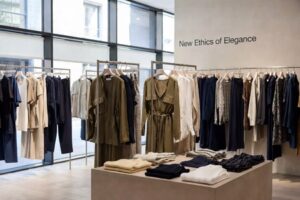
Inside, the boutique unfolds across three levels, structured by special furnishings inspired by Italian design from the 1950s. This reference point is neither arbitrary nor nostalgic. Post-war Italian design was defined by intellectual optimism, functional elegance, and material honesty—values that align closely with Prada’s long-standing ethos.
Rather than recreating a period aesthetic, the interior abstracts its principles. Wooden screens articulate the space, creating zones that offer depth and visibility while maintaining an intimate dimension. The result is a retail environment that encourages contemplation rather than consumption fatigue.
In an era where many luxury spaces lean heavily on theatricality—immersive lighting, oversized installations, and digital overlays—Prada’s interior strategy feels intentionally countercultural. The design prioritizes clarity of movement, visual rhythm, and psychological comfort. Luxury here is quiet, assured, and deeply considered.
Hong Kong as a Luxury Laboratory
Hong Kong occupies a unique position within the global luxury landscape. It is simultaneously mature and volatile, deeply knowledgeable yet increasingly discerning. The city has witnessed cycles of exuberant expansion and strategic contraction across luxury retail over the past decade.
Prada’s renewed presence at LANDMARK should be read within this context. This is not a speculative move. It is a calibrated response to a market that no longer rewards overexposure. Instead, it values credibility, cultural intelligence, and long-term commitment.
By anchoring itself within LANDMARK—an address synonymous with financial power, discretion, and global connectivity—Prada aligns with an audience that views luxury as an extension of identity rather than a signal of status. This is a consumer who values architecture, design lineage, and intellectual depth as much as product.
Fashion Retail as Spatial Narrative
What distinguishes this boutique is not only its design, but the narrative it constructs through space. Each level operates as a chapter rather than a department. The wooden screens subtly guide movement, offering partial reveals rather than immediate disclosure. This pacing mirrors the Prada brand itself—measured, cerebral, and intentionally layered.
The absence of overt branding within the interior is telling. Logos do not dominate; materials do. Surfaces, textures, and proportions carry the narrative weight. In doing so, Prada reinforces a fundamental luxury principle: when a brand is secure in its identity, it does not need to announce itself.
This approach resonates particularly well within the context of fashion and style events, where the focus is often on immediacy. Prada’s boutique operates in opposition to this rhythm. It invites time. It rewards observation. It positions fashion as a cultural dialogue rather than a seasonal transaction.
The Broader Implications for Luxury Fashion
Prada’s LANDMARK Hong Kong boutique reflects a broader recalibration underway in luxury fashion. As markets mature and consumer sophistication deepens, physical retail is being redefined. Stores are no longer sales points; they are strategic assets—architectural statements that communicate brand philosophy without words.
This opening reinforces Prada’s role as a thought leader within the industry. While many maisons chase digital novelty or experiential spectacle, Prada continues to invest in architecture, materiality, and intellectual coherence. The result is a retail presence that feels timeless rather than trend-responsive.
For fashion and style observers, this boutique offers a case study in restraint. It demonstrates how luxury can remain relevant not by amplifying noise, but by refining signal. In a world increasingly driven by speed and surface, Prada chooses depth and deliberation.
Conclusion: A Quiet Assertion of Power
The inauguration of Prada’s new boutique at LANDMARK Hong Kong is best understood not as an event, but as a statement of intent. It affirms the maison’s confidence in Hong Kong’s enduring relevance and its own capacity to evolve without dilution.
Through architecture that commands without overwhelming, interiors that reference heritage without sentimentality, and a spatial narrative rooted in intellectual clarity, Prada reinforces its position as one of the few luxury houses capable of balancing commerce with cultural authority.
For She Unfolds Life, this moment underscores a critical truth about contemporary luxury: the future belongs not to those who shout the loudest, but to those who build with precision, patience, and purpose.